#210 Why can Americans buy all things Chinese but not Chinese EVs?

Walk into almost any American store and you will find all sorts of products made in China. Smartphones, laptops, clothing, toys, household goods, and thousands of other products are imported from China every single day. But there is one product category that most American consumers never see: Chinese electric vehicles (EVs).
This is interesting because many countries around the world are already buying Chinese EVs. Companies such as BYD, NIO, XPeng, and Xiaomi have expanded rapidly across Europe, Latin America, Southeast Asia, and the Middle East. In fact, BYD sold more than 2.2 million electric vehicles globally in 2025, surpassing Tesla’s approximately 1.6 million deliveries.
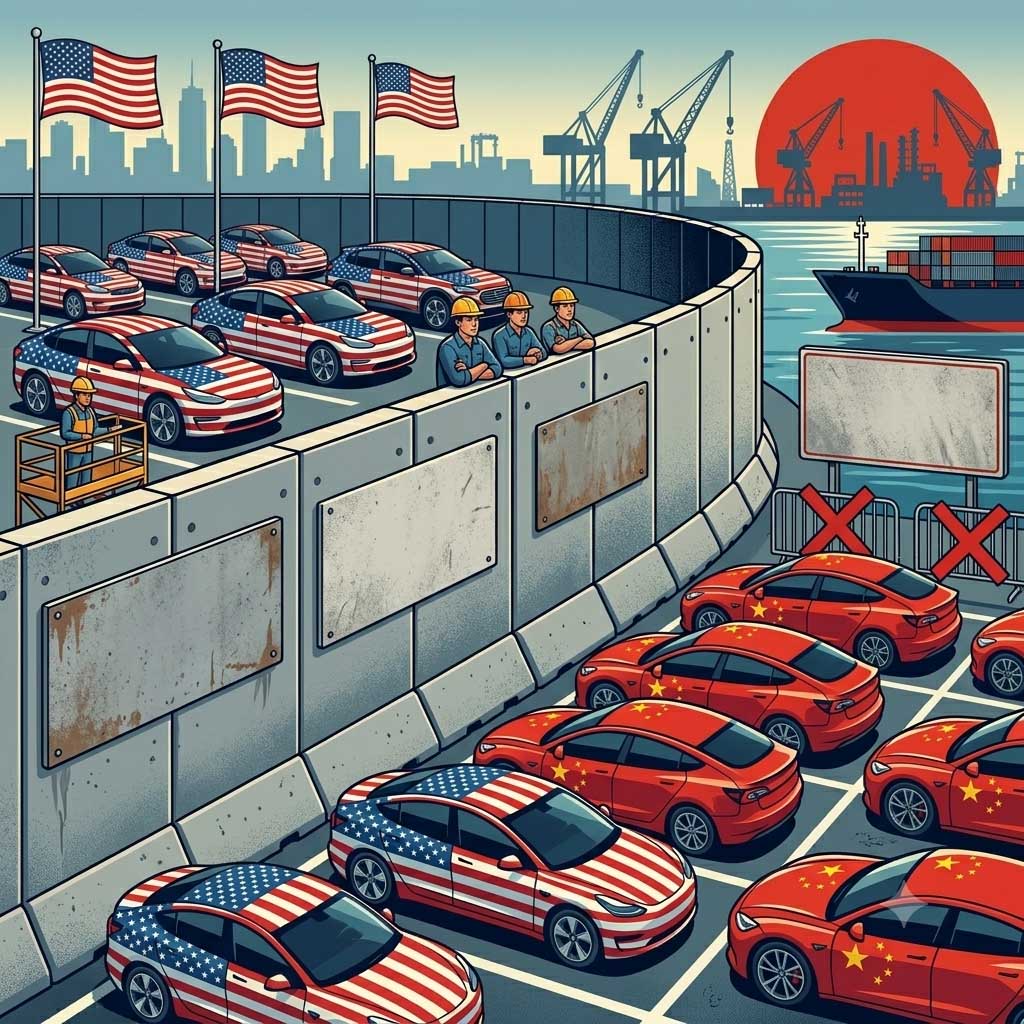
Many Chinese EVs are significantly cheaper than comparable Western vehicles. For example, some BYD models sell for less than $20,000 in China, while comparable Tesla models often cost considerably more. According to industry observers, one reason for BYD’s success is its ability to produce high-quality EVs at lower costs. American consumers have very limited access to these affordable Chinese EV brands. One major reason is government policy. The United States has imposed very high tariffs on Chinese electric vehicles and has also increased restrictions related to technology, data security, and connected vehicle systems. Call it policy or protectionism, these measures make it difficult for Chinese automakers to enter the U.S. market directly.
At the same time, the U.S. government is encouraging domestic EV production – with Chinese help. A good example is Ford’s battery plant in Michigan. Ford decided to build a battery factory in Marshall, Michigan, using technology licensed from CATL, a Chinese company that is considered one of the world’s leaders in EV batteries. The project was originally expected to create about 2,500 jobs, although later plans were reduced to approximately 1,700 jobs as EV demand slowed. The plans generated political debate because some lawmakers argued that the United States should reduce dependence on Chinese technology, while others believed access to advanced battery technology was necessary for American companies to remain competitive. Quite a square peg to fit into a round hole…
This case was written by Agassy Manoukian, American University of Armenia