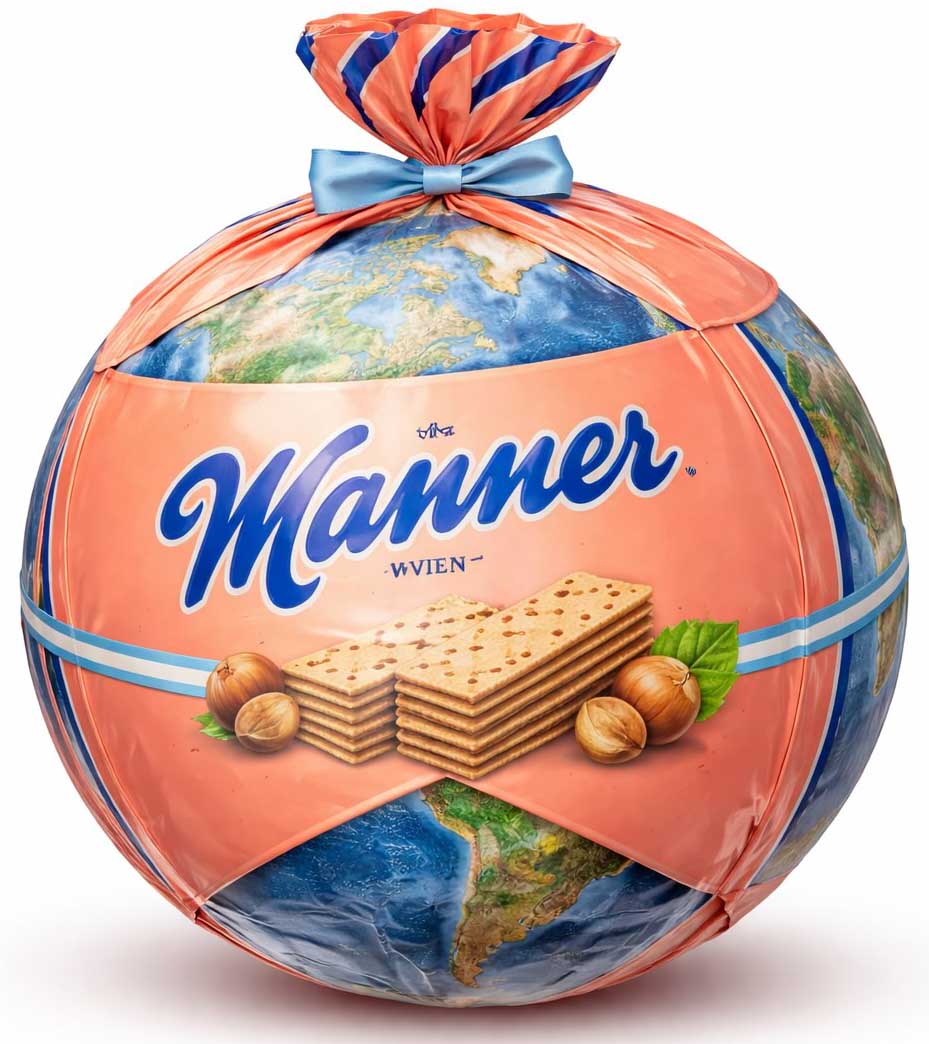
#205 Good Manners matter!

The pink packaging is instantly recognizable. Walk into a duty-free shop, a European delicatessen in New York, or a souvenir store near Vienna’s St. Stephen’s Cathedral and you will likely find a stack of Manner wafers. For more than a century, the company behind them – Josef Manner & Comp AG – has built its reputation on one product: the Neapolitan wafer, a light hazelnut-cream sandwich biscuit that has become synonymous with Vienna.
At first glance, the company appears to be a quiet success story of internationalization. More than half of Manner’s sales come from exports, and its products are sold in roughly 50 countries. For a relatively small Austrian confectionery company, that sounds impressive. But a closer look reveals a more complicated story – one that illustrates a classic risk in global business: confusing geographic reach with competitive strength.
Manner is, at its core, a pure export business. Unlike many global snack manufacturers, it has not pursued an aggressive strategy to capture a larger share of foreign markets, for instance via local sales or even production. Instead, the company produces almost everything in Austria and ships its wafers around the world in a more or less standardized manner (pun intended!). This approach keeps the brand tightly linked to its origins. The famous pink packages proudly emphasize their Viennese heritage. But at the same time it also creates a structural disadvantage. Producing primarily in Austria means higher labor and logistics costs than competitors who manufacture locally in major markets. And keeping the product as is, limits the prospects of a larger addressable market.
In other words, Manner exports not because it is necessarily the most cost-competitive producer, but because it has a product with cultural cachet. That cachet, however, is fragile. Wafers are among the easiest confectionery products to copy. The production process is simple, the ingredients are basic, and the format is universal. In many countries, local wafer brands with decades of tradition compete directly with Manner. In others, multinational giants dominate the snack aisle with enormous marketing budgets and global distribution systems. Companies such as Ferrero, Nestlé, or Mondelez International can easily replicate the product format while outspending smaller players on advertising and shelf space.
This leaves Manner with only two meaningful differentiators: its brand and its association with Vienna.
Both are valuable, but neither is sufficient, and the numbers illustrate the challenge. The share of exports in total sales initially looks impressive: more than half of the company’s revenue comes from outside Austria. But those exports are spread across around 50 markets. When viewed through that lens, the picture changes. Instead of a handful of large international strongholds, the company has a long tail of relatively small markets. Geographic presence does not necessarily translate into deep market penetration.
From the perspective of international strategy, Manner represents a subtle version of one of the deadly sins of international business: mistaking symbolic global presence for sustainable competitive advantage. Selling a little bit everywhere can create the illusion of global success, and it is expensive, too. But without strong positions in major markets, supported by either cost advantages or massive brand investment, international expansion risks becoming diffuse and fragile.
Manner’s wafers remain beloved, especially among consumers who associate the brand with Vienna and Austrian tradition. Yet the company operates in one of the most unforgiving categories of the global food industry: a product that is easy to copy, sold in crowded snack aisles, and contested by both nostalgic local brands and marketing powerhouses with billion-dollar budgets.
In that environment, exporting from Austria to 50 countries may look global. The harder question is whether it is truly competitive and sustainable.